
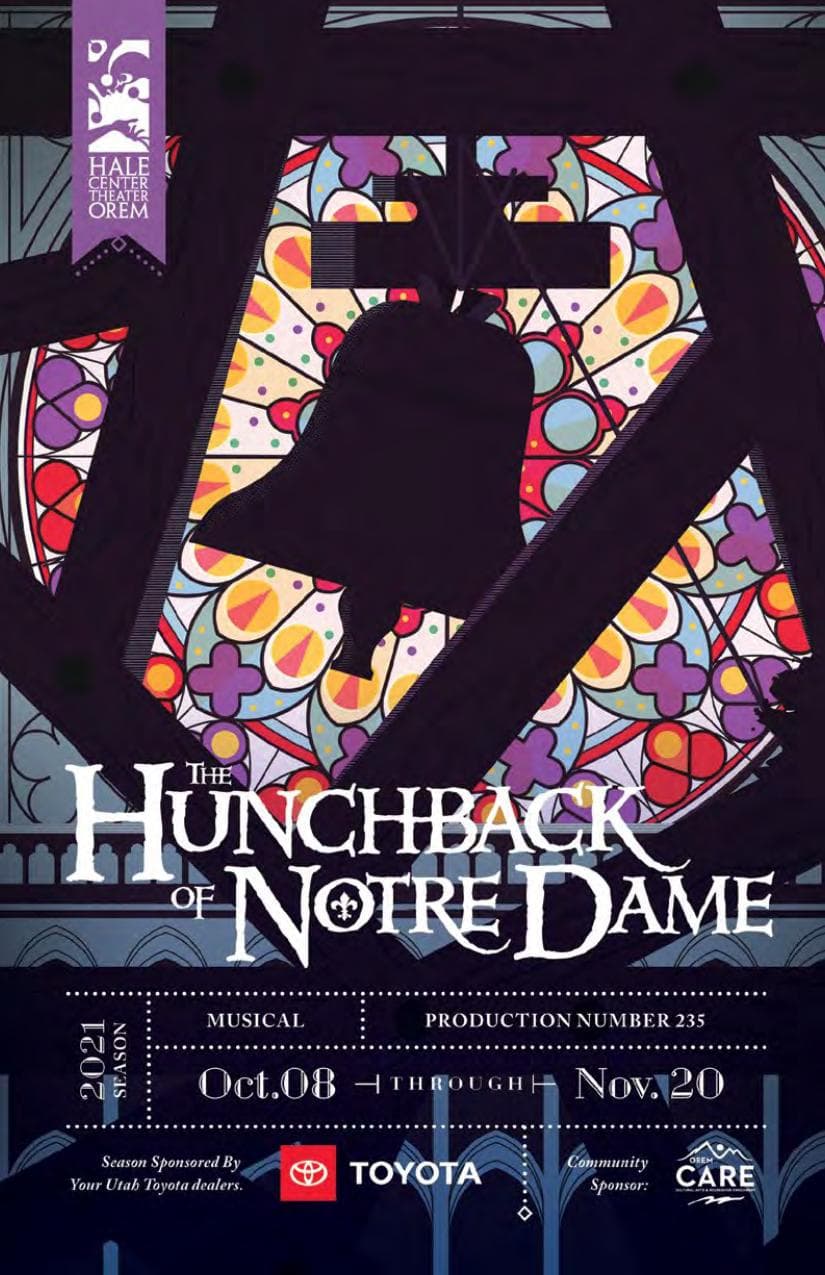
The Hunchback of Notre Dame
Oct 8, 2021 – Nov 20, 2021
The Hunchback of Notre Dame at Hale Center Theater Orem (Hale Center Theatre Orem). Run dates: Oct 8, 2021 – Nov 20, 2021. Closed. Cast, crew, posters, and production history from this Utah staging.
When I was 11 years old, I went through a bit of a culture shock. I moved from Nashville, TN to Sparta, NJ. I was a polite, southern boy thrown into the deep of hard- nosed New England right at the beginning of Junior High School. Needless to say, I was picked on, ridiculed, and outcast. That year, Disney released its newest animated feature, The Hunchback of Notre Dame. Never had a story moved me so much and spoke to me when I needed it most. Very soon after, I took a trip to Disneyland, where they were performing a new stage adaptation of the show. I was mesmerized. Seeing that show was one of those pivotal moments that helped define my passion and love for theater. Since then, I was waiting on bated breath for Disney to release this show as a stage adap- tation to the world, and when they did, the 11-year-old in me could not wait to be a part of telling this story. Although this version brings some interesting story elements from Victor Hugo’s book that the Disney film glosses over, its themes and messages still ring-out so powerfully, much like the Bells of Notre Dame themselves, thanks to the incredibly deep and moving music of Menken and Schwartz. It’s layers are endless, from the study of human history, religious and Latin meaning, to Victor Hugo’s intent and litera- ture, to the incredible way of melding musical theater and choral music to help tell this story. The lyric asks, “What makes a monster and what makes a man?”. This is the question our beloved writers wanted us to ponder as we watch the events unfold for our leading char- acters. One of my favorite moments from the Disney film was at the end, when Quasi enters the square and society is hesitant and fearful to let him in. But, one little girl leaves her nervous parent and walks up to Quasi, touches his deformed face, and holds him. To me, this is the answer to this question. We get to watch the parallels of how Quasimodo sees the world, innocent and unmarred, full of light and good, versus how Frollo sees it; deformed, ugly, evil, and of mal intent. A perfect example of this is the juxtaposition of Quasi’s song “Heaven’s Light” into Frollo’s song “Hellfire”, as they both discuss their views of love. Quasimodo sees the world much like a child. In my life as an educator and father, I am continually inspired by children and youth and their ability to teach me. Children don’t see ulterior motives tainted by years of disappointment or unmet expectations. They see it as a wonder, full of people deserving of love and affection. Another lyric states “I thought we all were the children of God”. Children. Brothers and sisters. Family. This theme gave me an idea. I wanted to have our story-teller, Clopin, have an audience; a little Gypsy child, who should, in her own right, feel the effects of a society looking down on her way of life, but instead, seeks out love and justice. The child keeps us in check through- out the story, keeping us grounded and focused on what truly matters. In the end, we can answer the question, “What makes a monster and what makes a man?” by stating, see your fellow man not as “monsters” or “deformities” or “gypsies”, but as a child sees them, as fellow children of God. Find the good. That is my hope and prayer with this production, to help remind people not to see the faults and the evil and the disappointment around them and in others, but to see the light, search for joy, and find the good, by DOING good. I hope this story and its music can bring the same light into your life as it has done in mine. Thank you, and let’s make “Someday come right now!”
Cast
34 in the cast





























Reviews & coverage
Professional coverage when we have links, a quick web search when we don't, and optional audience ratings from signed-in visitors.
Publication & critic links
No curated publication links yet.
Search the web for reviews
Opens Google in a new tab using this show's title and theatre context (results are not vetted by UTDb).
Search for reviews (Google)