
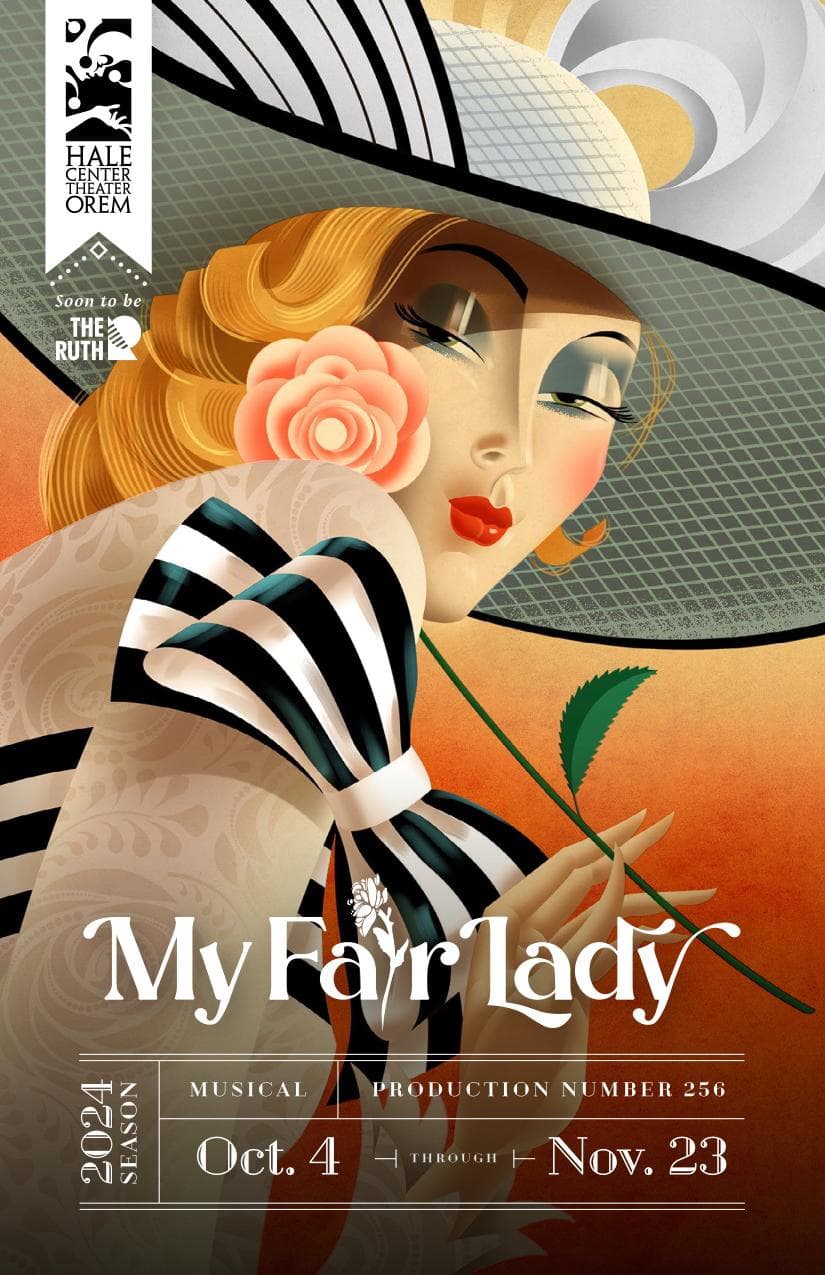
My Fair Lady

Oct 4, 2024 – Nov 23, 2024
My Fair Lady at Hale Center Theater Orem (Hale Center Theatre Orem). Run dates: Oct 4, 2024 – Nov 23, 2024. Closed. Cast, crew, posters, and production history from this Utah staging.
...is the story of a flower girl who wants to learn how to speak “properly” so she can sell flowers in a flower shop. My Fair Lady is the story of a man who believes he can transform a flower girl into a princess by teaching her to speak properly. My Fair Lady is based on George Bernard Shaw’s 1912 play, Pygmalion, in which Shaw comments on the social classes of his time, noting that in Edwardian England, mobility from one class to another was not possi- ble. Shaw believed that social orders were distinguished not only by a person’s birth and dress, but especially by their speech. Eliza Doolittle’s wants are simple, but her speech does not allow her the mobility of moving from selling flowers on the street to selling flowers in a flower shop. Enter, Henry Higgins, who believes that by changing the way a person speaks, he can address this lack of mobility between classes and demonstrate that class distinc- tions are fundamentally social constructs. Higgins’ work pays off at the Annual Embassy Ball, where Miss Eliza Doolittle is regarded by the most discerning as a member of the upper-class society. In fact, she is perceived to be a “Princess.” With the mission accomplished, Eliza experiences a personal identity crisis. She no longer feels she belongs selling flowers on the street or in a flower shop. She pays a visit to Henry’s mother, who deeply cares about Eliza and gives her some sound advice: “If my son begins to break things, I give you full permission to have him evicted.” My Fair Lady is not a typical love story. On one hand, it is a story about how Henry Higgins uses Eliza to test his theory of mobility between classes. On the other hand, all Eliza wants is to be treated with respect and kindness by Henry Higgins. Eliza is a fast learner and an excellent student. However, Higgins regards her as “a fool,” as “a plain idiot,” not because she was born into a lower class, but because she has the potential to move beyond her social position, if she will not only learn to speak properly, but also if she will learn to behave in ways that are worthy of being respected for her abilities and accomplishments. In the final scenes of the story, Higgins challenges Eliza to develop a backbone and become someone worthy of respect. And when she stands up to him and grows into her potential, he is pleased with her transformation! However, when she leaves him, (“Goodbye, Professor Higgins. What you will do without me, I cannot imagine.”) he is surprised, devastated, and upset. He misses her, not simply because she is a woman, but because she is an accom- plished person, his friend, and he wants to engage with her as his equal. My Fair Lady is a joyous and tender story of love and equality. - Rodger Sorenson
Cast
40 in the cast



























Reviews & coverage
Professional coverage when we have links, a quick web search when we don't, and optional audience ratings from signed-in visitors.
Publication & critic links
No curated publication links yet.
Search the web for reviews
Opens Google in a new tab using this show's title and theatre context (results are not vetted by UTDb).
Search for reviews (Google)